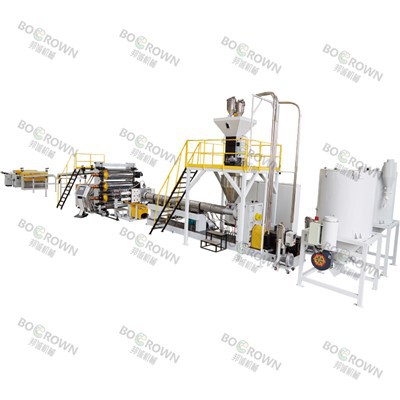
If you’ve ever held a sturdy takeout container, a clear produce clamshell, or a child’s flexible reusable water bottle, chances are good the product started its life on a sheet extrusion line running PE, PET, PP, or ABS. As a supplier of these lines, I’ve spent the last 12 years standing alongside food and packaging manufacturers, troubleshooting startup kinks, and celebrating when a line hits its first batch of food-grade sheet that passes regulatory checks on the first try. The number one question I get from new customers isn’t “how fast can we run?” or “how much does this line cost?”—it’s “what actually goes into making sheet that’s safe to touch food?” The answer isn’t just “good machinery.” It’s a mix of meticulous process control, strict material handling, regulatory alignment, and ongoing operator training that turns standard resin into food-grade sheet. Let’s break down what it actually takes to produce food-grade sheets on a PE/PET/PP/ABS sheet extrusion line, from the raw material bay to the final quality check. PE/PET/PP/ABS Sheet Extrusion Production Line

First, and non-negotiable, is the raw material qualification step. For food-grade output, this isn’t a “quick visual scan” of resin pellets. Every batch of PE, PET, PP, or ABS must come from a supplier that specializes in food-contact-grade resins, and your team needs to hold batch-specific documentation to prove it. I’ve seen customers cut corners here: once, a startup tried to save $0.10 per pound by mixing a batch of industrial-grade recycled PP with food-grade resin, and by the time they caught the lead leaching test failure, they’d already run 10,000 pounds of bad sheet that had to be scrapped. Food-grade resins have defined limits for heavy metals (lead, cadmium, arsenic), residual monomers, and volatile organic compounds (VOCs) that can transfer to food. For example, PET resin intended for food use can have no more than 0.5 ppm of acetaldehyde, a byproduct of polymerization that can make packaged food taste off. PE resin for food packaging has strict limits on extractables, which are substances that can move from the plastic into contact with food, especially fatty or acidic foods.
But raw resin isn’t the only raw material. Additives—things like slip agents, stabilizers, colorants, or antistatic agents—are critical to making sheet that’s workable, but they can be a huge food safety risk if chosen wrong. You can’t use just any additive; it has to be certified for food contact by bodies like the U.S. Food and Drug Administration (FDA) 21 CFR Part 174, 175, 177, or the European Union’s Regulation (EU) No 10/2011 on plastic materials and articles intended to come into contact with food. I always tell customers: never assume an additive is food-grade just because it says “safe for plastics.” Some slip agents, for example, work great for industrial sheet but have not been tested for food transfer. Once, a customer asked if they could use a cheap industrial slip agent to reduce sheet sticking to the roll, and our team had to walk them through the data that showed that specific slip agent would leach into acidic food like tomato sauce. The fix? Switching to a food-grade slip agent, which added 2% to their additive cost, but saved them from a 30-day shutdown when their first test batch failed regulatory testing.
Next comes the line setup and preparation, which is all about eliminating cross-contamination. Even if every batch of resin is food-grade, a line that previously ran industrial-grade plastic can ruin a food-grade run. That’s why we emphasize what we call “line sanitization protocols” for food-grade production. For new lines, that usually means a full disassembly of the extruder’s screw, barrel, screen changers, and die—parts where old resin, additives, or debris can get trapped. For existing lines switching over, we recommend running a purge compound designed for food-contact use to flush out residual industrial material. I’ve seen customers skip this step, only to find that a tiny bit of industrial ABS left in the screw ended up in their food-grade PP sheet, causing a trace of heavy metal that failed testing. It’s not just the extruder, either. The downstream equipment—calender rolls, pull rolls, slitter blades, and even the chiller water system—all need to be food-safe. Calender rolls that have been used for non-food sheet can have tiny scratches that trap residue, so we recommend covering or replacing rolls when switching to food-grade production, or using food-safe lubricants on roll adjustment components. Chiller water, too, must be potable grade and regularly tested for bacteria, because if the water feeding the chiller has E. coli or other pathogens, it can transfer to the sheet surface.
Process control is another make-or-break factor for consistent food-grade sheet. Extrusion is a thermal process, and too much or too little heat can create byproducts that are unsafe for food. For PET, for example, overheating the barrel can cause the resin to degrade, producing more acetaldehyde than allowed by food regulations. For PP, which has a lower melting point than ABS, running the extruder at too high a temperature can release VOCs that are restricted in food-contact materials. That’s why our lines come with precision thermocouples placed at multiple points along the barrel, not just a single temperature gauge at the inlet. We also recommend using closed-loop control systems that automatically adjust temperature and screw speed, rather than manual settings that can vary from operator to operator. Screw speed is also critical: running the screw too fast can shear the resin excessively, leading to more degradation and higher levels of extractables. For food-grade runs, we usually advise customers to run at 80-90% of the line’s maximum screw speed, to give the resin time to melt uniformly without over-shearing.
The screen changer is a small part that has a huge impact on food safety. Screen changers filter out any unmelting resin, debris, or contaminate particles from the molten plastic. If a screen is too coarse, it can let in a small particle of old resin or additive that causes a failed test. If it’s too fine, it can cause pressure spikes that lead to uneven sheet thickness, which is a quality issue, but also can degrade the resin. For food-grade production, we recommend continuous screen changers that allow you to change screens without stopping the line, rather than platen screen changers that require a shutdown. Stopping the line to change screens can lead to “dead zones” in the extruder where resin sits and degrades, creating hot spots that produce unsafe byproducts. Our continuous screen changers are designed specifically for food-use extrusion, with easy-to-clean screen housings that don’t trap debris between runs.
Downstream processing has its own set of requirements for food-grade sheet. After the molten plastic exits the die, it goes through a calendering or casting process to form a uniform sheet. For food-grade, the surface of the sheet must be free of defects, because any tiny scratch, bubble, or dust particle can harbor bacteria or become a point where food can stick and transfer contaminants. The chill roll system, which cools the sheet to lock in its shape, must be perfectly smooth and made of food-grade material. We use chrome-plated chill rolls that are polished to a mirror finish, because rough surfaces can trap residue. Pull rolls must also be soft enough to not scratch the sheet, but firm enough to pull it evenly, and their rubber coatings must be food-grade, not industrial rubber that can leach chemicals. Even the slitter at the end of the line—used to cut the sheet to size—must have sharp, clean blades, and the dust generated from slitting must be contained in a food-safe collection system, not released into the air where it can land on the sheet surface.
Testing and documentation are the final pieces of the puzzle, and they’re non-negotiable for food-grade product. You can have the best line, the best resin, and the best processes, but if you don’t test every batch of sheet to prove it meets regulatory standards, you can’t sell it as food-safe. There are two types of testing: in-line quality checks and third-party regulatory testing. In-line, your team should test sheet thickness every 15 minutes to ensure uniformity, and do a visual inspection for defects. But for food safety, you need to do extractables testing and migration testing to confirm that no substances from the plastic transfer to food. For example, if your sheet is used for packaging raw chicken, you need to test how much fat from the chicken can extract into the plastic, and vice versa. This testing is usually done by a third-party lab that is certified to do food contact testing, and the results must be kept on file for every batch—regulators like the FDA can audit these records at any time, and failure to produce them can result in fines or a product recall.
Operator training is often overlooked, but it’s one of the most critical requirements. I’ve seen highly automated lines produce bad food-grade sheet because an operator skipped a sanitization step, or adjusted the temperature without logging it. Food-grade extrusion isn’t a set-it-and-forget-it process; it requires operators who understand not just how to run the line, but why each step matters for food safety. For example, an operator who knows why we use food-grade additives will understand why they can’t add a different additive mid-run without checking with the quality team, whereas an operator who only sees a line as a machine to make sheet might not think twice about it. We provide comprehensive training for every customer’s team, including hands-on practice with sanitization protocols, line setup, and testing, plus annual refreshers to keep up with changes in food regulations.
It’s worth noting that different resins have unique requirements for food-grade production. For example, ABS is less common for food contact, but when used (often for rigid packaging or appliance parts that come into contact with food), it has stricter limits on residual acrylonitrile, a monomer that is toxic. PP, on the other hand, is widely used for food containers, and its low density makes it a popular choice, but it’s prone to static, so you need a food-grade antistatic additive that doesn’t compromise safety. PE comes in low-density (LDPE) and high-density (HDPE) forms, both used for packaging, and requires careful control of melt index to ensure consistent performance. PET, used for clear packaging like water bottles, has strict limits on acetaldehyde, as I mentioned earlier, so process control of temperature is especially important here.
At the end of the day, producing food-grade sheet on a PE/PET/PP/ABS sheet extrusion line is about attention to every detail—no small shortcut is worth the risk of a failed batch, a recall, or harm to consumers. If you’re setting up a new line to produce food-safe sheet, or upgrading an existing line to meet current regulatory standards, our team has decades of experience designing lines that meet all these requirements, from raw material bays that prevent cross-contamination to operator training programs that keep safety front and center. We work with you every step of the way, from line design to startup to ongoing support, to ensure your food-grade sheet is consistent, safe, and compliant with all global regulations.
If you’re ready to discuss your specific needs, or have questions about how to adjust your current line for food-grade production, reach out to our team to schedule a consultation. We can walk you through our line designs, share case studies of customers who have successfully switched to food-grade production, and help you create a plan that fits your business goals.
PE Centralized Feeding System REFERENCES
- U.S. Food and Drug Administration. (2024). 21 CFR Parts 170–199: Food, Drugs, and Cosmetics. U.S. Government Publishing Office.
- European Commission. (2011). Regulation (EU) No 10/2011 on plastic materials and articles intended to come into contact with food. Official Journal of the European Union.
- Harper, C. A. (2011). Extrusion: The Definitive Processing Guide and Handbook (2nd ed.). William Andrew Publishing.
- Rosato, D. V., & Rosato, M. G. (2004). Plastic Product Material and Process Selection Handbook. Elsevier.
- Institute of Food Technologists. (2022). Food Contact Substances: Safety, Regulation, and Testing. IFT Press.
ZJG BC Machinery Co., Ltd.
As one of the most professional pe/pet/pp/abs sheet extrusion production line manufacturers and suppliers in China, we’re featured by quality products and good price. Please rest assured to buy cost-efficient pe/pet/pp/abs sheet extrusion production line for sale here from our factory. Contact us for custom service and OEM service.
Address: No.8 Lexi Road, Leyu Town, Zhangjiagang City
E-mail: sales@bcextruder.com
WebSite: https://www.bcextruder.com/
